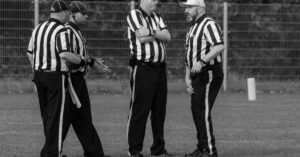
Football, undeniably the world’s most prestigious sport, transcends borders and cultures thanks to its apparent simplicity and captivating intensity. Yet, behind every thrilling match lies a regulatory and strategic complexity that ensures fairness, spectacle, and safety. Understanding the basics of football means grasping the very essence of this universal game, from the careful choice of equipment to the subtleties of the rules on the pitch, including the importance of refereeing and team dynamics. In France, its popularity continues to grow, both at the amateur and professional levels, fueled by the enthusiasm of fans and the excellence of clubs like PSG, OM, and OL. The modern evolution of football, marked by the introduction of technologies such as VAR, and the rise of women’s football, testifies to a sport that is constantly evolving and remains accessible and exciting for all. This in-depth exploration invites you to discover the fundamental pillars of football, so you can more fully appreciate each match and, perhaps, take to the pitch with confidence and knowledge.
Understanding the essential equipment and technical specifications of the football
Before taking to the pitch, each player must wear equipment that meets international standards, ensuring safety and comfort. The kit typically includes a long-sleeved or short-sleeved jersey depending on the weather conditions, shorts, and socks covering the shin guards—essential accessories for preventing injuries. The choice of cleats, which can vary depending on the surface (natural or artificial turf), is crucial. Brands such as Nike, Adidas, Puma, Umbro, Kappa, Mizuno, New Balance, Hummel, Diadora, and Joma dominate the market, offering a wide range tailored to the specific needs of players.At the same time, the central element of the game is, of course, the ball. According to FIFA rules, the ball must be perfectly spherical, with a circumference between 68 and 70 cm and a weight ranging from 410 to 450 grams at the start of the match. Traditionally white, its design can vary to improve visibility depending on the light and atmospheric conditions. This uniformity guarantees consistent playability, essential for control, shooting, and dribbling. A prime example: the use of high-tech models with composite materials designed to optimize trajectory precision and limit deformation upon impact. 🔹 Mandatory kit: jersey, shorts, socks, shin guards, appropriate studs 🔹 Ball: spherical, 68-70 cm circumference, 410-450 g🔹 Key equipment brands: Nike, Adidas, Puma, Mizuno, Kappa, Umbro 🔹 Studs vary depending on natural or synthetic turf🔹 Importance of comfort and safety Element ⚽️Standards 📏 Example / Brand ✨Ball Circumference 68-70 cm, weight 410-450 gHigh-tech models, Adidas Al Rihla Jersey & ShortsComfort, durability, in team colors Nike Mercurial, Puma LigaShin guards Mandatory protection, FIFA compliance Kappa, Hummel Studs Suitable for the type of pitch
Mizuno Morelia, New Balance Furon
- Compliance with regulations is verified by the referee before each match, ensuring strict adherence to the rules and equal conditions for all players. This preliminary step is essential to the smooth running of the match, avoiding technical issues and even penalties.
- Discover the basics of soccer: essential rules, techniques, and strategies for getting started and progressing in this exciting sport. Whether you’re a player or an amateur, learn everything you need to know to fully enjoy the game.
- Pitch Dimensions and Rules: The Essential Framework for the Game of Soccer
- The soccer pitch is the arena of the game, a strictly defined rectangle where actions and strategies unfold. According to international recommendations, official dimensions vary: the length ranges between 90 and 120 meters, while the width ranges between 45 and 90 meters. These measurements are often adapted according to the level and age of the players, with youth pitches naturally being smaller to facilitate better learning. The surface is covered with either natural or synthetic turf. The latter, although controversial, is widely used for its durability and moderate impact on players’ health, particularly the risk of ankle sprains and various injuries, which can be discussed in more detail here. Each end houses a goal, measuring precisely 7.32 meters wide and 2.44 meters high, a confined space that requires skill and precision to score a goal. All around, white lines define the boundaries of the pitch, the penalty area, and specific zones such as the halfway line, the corner kick area, and the penalty box.
- 📏 Standard dimensions: length 90-120 m, width 45-90 m
| 📍 Natural or synthetic turf surface | 🥅 Goals: 7.32 m wide, 2.44 m high | 📐 Lines: Delineate the pitch, penalty area, touchline zones, and corner kicks |
|---|---|---|
| ⚠️ Injury prevention related to the type of surface | Pitch area 🌐 | Dimension / Feature 🔎 |
| Importance in the game 🎯 | Total length | 90-120 meters |
| Provides sufficient playing space for various strategies | Total width | 45-90 meters |
| Width influences wing play and passing | Penalty area | 16.5 m from the goal line |
Area where the goalkeeper can use his hands, potential penalties

7.32 m x 2.44 m
Primary objective of shots and goals It is interesting to note that the configuration of the pitch directly influences the tactics adopted. For example, a wide pitch favors flanks and quick attacks, highlighting the key importance of wingers, whose role is detailed here. Conversely, a smaller pitch favors close duels and midfield play.https://www.youtube.com/watch?v=YqTUCzKNV-c
The Fundamental Rules of Football: Where the Laws of the Game Meet
- In both official and amateur competitions, football is governed by a specific set of rules, defined by the IFAB (International Football Association Board). Knowing these rules is essential to understanding the dynamics and fluidity of the game. A standard match pits two teams of 11 players, each including a goalkeeper, against each other over a regulated duration of two 45-minute periods, separated by a 15-minute break.
- The goal of the game is to kick the ball into the opponent’s goal while respecting various prohibitions, such as the use of arms or hands by outfield players. A recurring foul that is a source of debate is offside. A player is offside if, at the moment a teammate passes the ball to them, they are closer to the opponent’s goal line than the ball and the second-to-last defender. This principle aims to ensure team play and prevent unfair advantages. Its application is now facilitated by Video Assistance Reconciliation (VAR), a revolutionary technology that is redefining refereeing. ⏳ Match duration: 2 x 45 minutes, 15-minute break
- ⚽️ Each team: 11 players including a goalkeeper
- 🚫 No use of arms/hands except the goalkeeper in his own box
- 📉 History of offside: avoiding anticipated positions
| 🎥 VAR: video review for fair decisions (goals, cards, offside) | Rules of the game 📝 | Clear description 🔍 |
|---|---|---|
| Impact on the match ⚽️ | Duration | Two 45-minute halves, 15-minute break |
| Maintains players’ rhythm and stamina | Roster | 11 players, including goalkeeper |
| Balanced structure between attack and defense | Offside | Player more advanced than the ball and the second-to-last defender at the moment of the pass |
| Promotes team play and prevents tactical abuse | VAR | Video intervention in 4 specific cases |
Reduction of significant refereeing errors The center referee, assisted by two assistant referees on the wings, ensures compliance with these rules. He sanctions fouls with free kicks, penalties, or colored cards (yellow for a warning, red for a dismissal). This discipline regulates player behavior and ensures the safety and fairness of the game. To better understand the different types of fouls and expected behavior, it is recommended to consult this page dedicated to injuries and prevention in football.https://www.youtube.com/watch?v=DMZuosVLVow
At the heart of the defensive role, the goalkeeper benefits from a unique exception: the use of his hands inside his penalty area. This specificity is crucial because it allows him to intercept, control, and then pass the ball to protect his goal. However, the goalkeeper must comply with several restrictions, such as not intentionally catching a pass from a teammate or not holding the ball for more than six seconds, under penalty of indirect sanction.
This position requires excellent concentration, sharp reflexes, and a good reading of the game. Famous goalkeepers like Manuel Neuer revolutionized this role thanks to their skill in quick clearances and active participation in team play.
✋ Exclusive use of hands inside the penalty area
- ⏱ Maximum possession of 6 seconds with the ball in hand
- ❌ No intentional passes to be caught by teammates
- 🧤 Importance of reflexes and positioning
- ⚠️ Penalties for non-compliance with the rules
- Goalkeeper’s action 🤾
| Allowed or prohibited? ✅❌ | Consequence ⚖️ | Interception of the ball in the penalty area |
|---|---|---|
| ✅ Allowed | Fluid play, reinforced defense | Deliberately kicking a ball |
| ❌ Prohibited | Indirect free kick to the opponent | Goalkeeper holds for more than 6 seconds |
| ❌ Prohibited | Indirect free kick | Use of hands outside the penalty area |
| ❌ Foul | Possible yellow/red card | To ensure fair and smooth management, the referee now uses technological tools such as VAR, particularly to verify decisions that have a significant impact on the course of the match: valid goals, penalties, expulsions, or mistaken identities. They are also responsible for punishing fouls with yellow or red cards, the latter leading to immediate exclusion. The distinction between a direct red card and a second yellow card is important. A direct red card is a serious foul or unsportsmanlike conduct, often followed by a longer suspension, while two yellow cards are a sign of repeated but less severe offenses, with a generally more moderate disciplinary sanction. |
🟥 Direct red card = serious foul, immediate exclusion 🟨 Second yellow card = exclusion for multiple yellow cards⚙ VAR applied to goals, penalties, red cards, and mistaken identity
🚨 Disciplinary sanctions affecting team dynamics
Type of Card 🗂
Common Reasons 🏷️
- Consequences ⚠️
- 🟥 Direct Red Card
- Dangerous tackles, assaults, unsportsmanlike behavior
- Immediate exclusion, minimum 1-match suspension
- 🟨 Yellow Card
| Warnings for technical fouls, protests, simulation | Warning, cumulative leading to a red card | Red card per accumulation |
|---|---|---|
| Two successive fouls sanctioned by yellow cards | Exclusion, often a one-match suspension | Players and coaches are advised to take official training, such as the |
| BMf – Football Instructor Certificate | , to better master these regulatory and educational aspects. | Football: Team Dynamics, Competitions, and Amateur Commitment |
| Beyond the rules, football is above all a team sport based on collaboration, strategy, and respect. The eleven players distributed across the pitch fulfill specific roles: defenders, midfielders, wingers, forwards, and goalkeeper. This organization allows for a variety of tactical schemes, ranging from the classic 4-4-2 to the 3-5-2 or other more modern systems. Wingers play a major role in width and splits, illustrating a rich tactical history that can be explored further via this link: | Wingers and Flank Control | . |
| On a competitive level, football brings together millions of fans, both amateurs and professionals. In France, Ligue 1 symbolizes national excellence, while the FIFA World Cup and the UEFA Euro 2020 are flagship events between nations. Women’s football, which is booming, has also earned its reputation with regular major competitions, driven by iconic figures and constantly increasing media coverage. | The rise of amateur football is equally significant. Played in schools, local clubs, and even in neighborhood tournaments, it serves as a popular way of life, instilling values of hard work, solidarity, and fair play. However, it is essential to consider the physical dimension of the sport, particularly the prevention of common injuries such as ankle sprains, a topic explored in more detail here: | Preventing Sprains in Football |
. 🤝 Fundamental teamwork on the pitch
- 🎯 Varied roles: defenders, midfielders, forwards, goalkeeper
- 🏆 Major competitions: Ligue 1, World Cup, Euro
- 👩 Women’s football on the rise
- ⚕ Attention to injury prevention in amateur practice
- Aspect of Football ⚽️
| Main characteristic 🌟 | Impact on practice 👥 | Tactical organization |
|---|---|---|
| Various formations (4-4-2, 3-5-2, etc.) | Allows adaptation to players and opponents | Professional competitions |
| Ligue 1, World Cup, Euro | Mobilizes millions of fans | Women’s football |
| Dedicated teams and competitions | Increased visibility, continuous development | Amateur football |
Societal and educational practice Promotes access to sport for allInjury prevention
Adapted protocol and advice
Maintaining athletic health Commitment to Football, whether competitive or recreational, relies on a blend of enthusiasm, tactical rigor, and mutual respect. Coaching organizations often offer state diplomas, such as the State Football Diploma, to professionalize this sector. Similarly, good psychological management, described in this article on player morale, is crucial to optimizing collective and individual performance.https://www.youtube.com/watch?v=IIOQ_SlDYUs
FAQ – Frequently Asked Questions about the Basics of Football
❓ What is the main role of shin guards in football?Shin guards protect the legs from impact and injury, particularly during tackles. They are mandatory for playing.
- ❓
- How is offside calculated?
- A player is offside if they are closer to the opposing goal than the ball and the second-to-last defender at the moment their teammate passes them the ball.
- ❓
- What can a goalkeeper do with their hands?
| A goalkeeper can only use their hands in their penalty area to catch or clear the ball, but they cannot intentionally take a pass from a teammate. | ❓ | What is the difference between a straight red card and a second yellow card? |
|---|---|---|
| A straight red card is a serious offense with an immediate sending-off and often a longer suspension, while two yellow cards result in a sending-off for multiple cautions, usually with a shorter penalty. | ❓ | What equipment is required to legally play a football match? The player must wear a jersey, shorts, socks, compliant shin guards and shoes suitable for the pitch. |